Unfortunately, I have discovered recently that I can't take credit for coining the term "Simplicitude". While I was completely unaware of earlier (if not sparse) uses of the word, I used it as early as late 2000 to describe a musical form that was beginning to crystallize in my composing sessions. The nascent concept was the combination of "simplicity" with "étude".
The earliest documented reference I have been able to find is a 1985 UNESCO publication produced by Harold J. Noah and Max Eckstein entitled "Dependency Theory in Comparative Education: The New Simplicitude". Since I've not been able to read that document, I have no idea what meaning the word had within their context.
In fact, while a Google search returns nearly 2,000 hits for the word, many of those hits are (unauthorized) links to my own original website and MP3 files I had posted of the original Simplicitude recording project. Interestingly (given my training in English & French literature as well as linguistics), many of the Google hits are on Francophone sites. I have yet to find a formal definition.
As I stated, the original concept was a combination of "simplicity" (not to be confused with "simplistic") combined with "étude, a term connoting a musical study. So, in one sense, simplicitude can mean a study in simplicity. As with many words, "simplicitude" can be applied in various contexts, so my definition within a musical context need not constrain its usage. It certainly could take on broader literary application.
As the concept began to take shape, and as the voice of my composing began to mature and take on a solid, individualistic form, the definition became more precise: "Simplicitude is a musical form that explores the natural tensions, conflicts, and contrasts that form the basis of understanding for any human experience. For example, joy without sorrow would be hollow; Love without justice would be trite; Relationship without vulnerability would be worthless."
In keeping with the tenor and intent of my musical compositions, "simplicitude" is intended to convey a positive connotation, combining the notions of truth (verisimilitude), simplicity, profundity, and study. Conversely, it is NOT intended to convey the negative connotation associated with "simplistic".
The upshot: I may not be able to take (complete) credit for coining the term, but I will take credit for defining it :-)

About the Composer
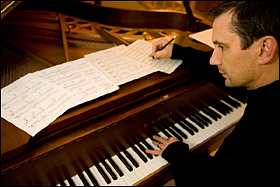
- Daniel G. Beckett, Jr.
- Plymouth, MI, United States
- Dan Beckett has a long history of composing, arranging, performing and producing for aspiring singer/songwriters, including Men of Grace, Emily Danielson, Calvin Thompson and Jim Barber. He produced three full length recordings while a member of Detroit-area Christian rock bands Times 7 and Rhev21, opening for national recording artists such as Small Town Poets, Geoff Moore, The Sparks, Russ Taff, and others. He is also active in his community, providing Music Therapy outreaches to various health care systems, performing benefit concerts and donation campaigns for Cancer Awareness, serving on the inaugural Canton Arts Commission in 2005, and producing recordings for the Plymouth Canton Educational Park music program. In addition to hammering away on acoustic piano, he also has been known to lay down the occasional Hammond B3 organ riff, as well as wailing sax leads. A self-taught musician, Beckett has a degree in English from Oakland University, and works vocationally as an Information Security specialist.
No comments:
Post a Comment