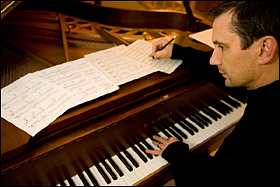
Unfortunately, I have discovered recently that I can't take credit for coining the term "Simplicitude". While I was completely unaware of earlier (if not sparse) uses of the word, I used it as early as late 2000 to describe a musical form that was beginning to crystallize in my composing sessions. The nascent concept was the combination of "simplicity" with "étude".
The earliest documented reference I have been able to find is a 1985 UNESCO publication produced by Harold J. Noah and Max Eckstein entitled "Dependency Theory in Comparative Education: The New Simplicitude". Since I've not been able to read that document, I have no idea what meaning the word had within their context.
In fact, while a Google search returns nearly 2,000 hits for the word, many of those hits are (unauthorized) links to my own original website and MP3 files I had posted of the original Simplicitude recording project. Interestingly (given my training in English & French literature as well as linguistics), many of the Google hits are on Francophone sites. I have yet to find a formal definition.
As I stated, the original concept was a combination of "simplicity" (not to be confused with "simplistic") combined with "étude, a term connoting a musical study. So, in one sense, simplicitude can mean a study in simplicity. As with many words, "simplicitude" can be applied in various contexts, so my definition within a musical context need not constrain its usage. It certainly could take on broader literary application.
As the concept began to take shape, and as the voice of my composing began to mature and take on a solid, individualistic form, the definition became more precise: "Simplicitude is a musical form that explores the natural tensions, conflicts, and contrasts that form the basis of understanding for any human experience. For example, joy without sorrow would be hollow; Love without justice would be trite; Relationship without vulnerability would be worthless."
In keeping with the tenor and intent of my musical compositions, "simplicitude" is intended to convey a positive connotation, combining the notions of truth (verisimilitude), simplicity, profundity, and study. Conversely, it is NOT intended to convey the negative connotation associated with "simplistic".
The upshot: I may not be able to take (complete) credit for coining the term, but I will take credit for defining it :-)
Thursday, January 3, 2008

Wednesday, January 2, 2008
The Simplicitude Concept
The idea behind Simplicitude is not to impress with musical virtuosity. Nonetheless, Simplicitude is an artistic ideal. As such, Simplicitudes should pay tribute to composers of esteem. Just the same, the objective of a Simplicitude is to be imminently accessible, to listener and performer alike.
The listener should be able to recall a selection subconsciously, and should be moved by the emotion of it. It should appeal to an understanding of musical grammar and syntax, but not require such learning to be enjoyed. It should linger without annoying; it should be emotive but not sentimental; it should be familiar and yet fresh.
The performer should be challenged to express in new ways, whether in meter, key, voicing, modulation, etc. It should require skill, discipline, and mastery, but not to the extent that reproducing it becomes unattainable. It should aspire without hubris; it should inspire without daunting; it should emulate without imitating.
Simplicitude is a musical form that explores the natural tensions, conflicts, and contrasts that form the basis of understanding for any human experience. For example, joy without sorrow would be hollow; Love without justice would be trite; Relationship without vulnerability would be worthless. As human beings, we acclimate to our environment; without contrast, our existence becomes mundane.
Someone once said, "The difference between joy and sorrow is a single note". Indeed, the greatest pain frequently accompanies the things most priceless in life. Hence, if a selection seems to pervade with a certain mood, be it blissful or melancholy, perhaps it is only so in context to the mood of the listener and performer. The mood of the music resonates with the mood of the listener and performer at a moment in time. And in that moment, the mood crystallizes in the mind into the essence of conflict that adds richness to our lives.
The listener should be able to recall a selection subconsciously, and should be moved by the emotion of it. It should appeal to an understanding of musical grammar and syntax, but not require such learning to be enjoyed. It should linger without annoying; it should be emotive but not sentimental; it should be familiar and yet fresh.
The performer should be challenged to express in new ways, whether in meter, key, voicing, modulation, etc. It should require skill, discipline, and mastery, but not to the extent that reproducing it becomes unattainable. It should aspire without hubris; it should inspire without daunting; it should emulate without imitating.
Simplicitude is a musical form that explores the natural tensions, conflicts, and contrasts that form the basis of understanding for any human experience. For example, joy without sorrow would be hollow; Love without justice would be trite; Relationship without vulnerability would be worthless. As human beings, we acclimate to our environment; without contrast, our existence becomes mundane.
Someone once said, "The difference between joy and sorrow is a single note". Indeed, the greatest pain frequently accompanies the things most priceless in life. Hence, if a selection seems to pervade with a certain mood, be it blissful or melancholy, perhaps it is only so in context to the mood of the listener and performer. The mood of the music resonates with the mood of the listener and performer at a moment in time. And in that moment, the mood crystallizes in the mind into the essence of conflict that adds richness to our lives.
Subscribe to:
Comments (Atom)